EUVIMED · PRESS INTERVIEW
“Medical knowledge must not become an instrument of political pressure”
Prof. Dr. Andreas Lauterbach on EUVIMED and Europe’s access to scientific literature
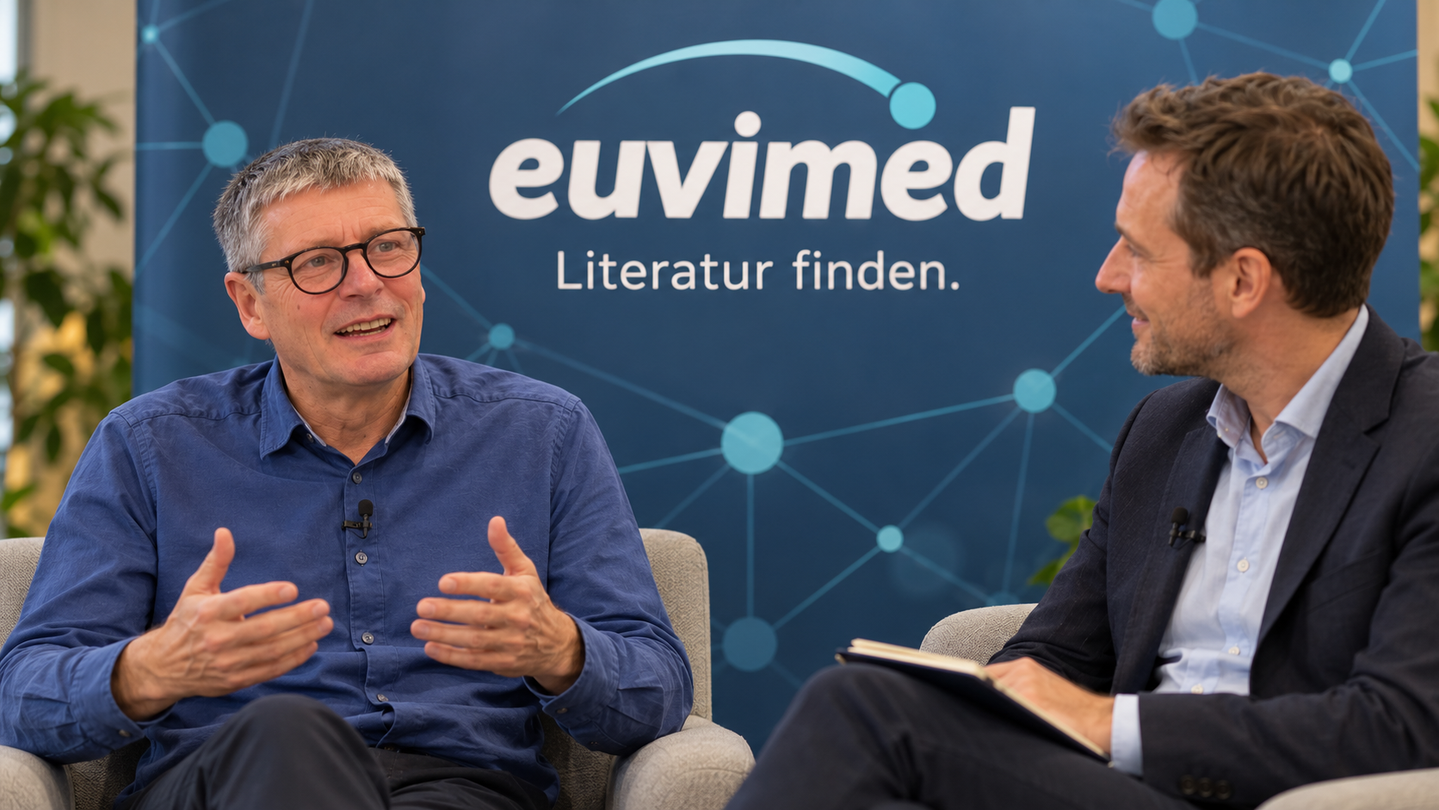

Reliable sources are essential to inform medical decisions. But how robust is an information supply that depends on just a few central services? Prof. Dr. Andreas Lauterbach explains how EUVIMED brings together international research and German-language specialist literature, obtains data directly from publishers and aims to reduce dependence on individual access routes.
Professor Lauterbach, what is EUVIMED — in three sentences?
Prof. Dr. Andreas Lauterbach: EUVIMED stands for a European approach to accessing scientific literature in medicine, nursing, therapy and health sciences. We combine international publication data with German-language specialist literature and tools for further scientific work. Our aim is to make knowledge easier to find and support its availability through several sustainable source pathways.
What specific problem is the platform intended to solve?
Scientific knowledge is distributed worldwide, yet in everyday work many people repeatedly rely on the same few access points. That is convenient, but it creates dependencies. We want to offer a search service operated in Europe that combines established international collections with additional sources and continuously incorporates new publications.
This raises a very practical question: can researchers, educators and people delivering care continue working if an important service fails or changes its access conditions? Resilience becomes evident when a data route fails. That is why we focus not only on the search interface, but also on how publication data reaches us, is checked and remains searchable over time.
Where does your data come from, and what do you check using Crossref?
We obtain a large proportion of our metadata directly from publishers. This includes, for example, information on titles, authorship, journals and publication years. We compare these deliveries with the DOI data registered with Crossref. A DOI is a persistent identifier for a publication; it helps us match records and check bibliographic information for inconsistencies.
Crossref is an important reference source for this, but it does not cover every publication or every data field in full. A DOI comparison is also no substitute for assessing scientific quality. We therefore combine direct deliveries with other supply routes. Through national and international partners, we incorporate additional metadata and, where the necessary usage rights are available, full texts. In Germany, these partners include CareLit. We currently work with around 110 metadata providers and data aggregators. This diversity is intended to prevent a single supply route from determining the availability of the entire search service.
Europe PMC and OpenAlex already exist. What justifies another provider?
These services are valuable components of scientific information provision, but some of their activities also depend on PubMed/MEDLINE, making them vulnerable to disruption in those areas. We deliberately include them. Our own contribution lies in combining different sources with direct publisher deliveries, our own search indexes and a working environment for the health professions. For institutions, what matters is which data routes actually remain available when something changes at a service.
Developments in US science policy have made clear that the funding and operation of information infrastructures depend on political conditions. Medical knowledge must not become an instrument of political pressure. For me, this creates a European responsibility: we must build and test additional access routes before we urgently need them. EUVIMED aims to reduce dependence on a single service such as PubMed. International cooperation remains indispensable; for us, independence means having our own options for action when disruption occurs.
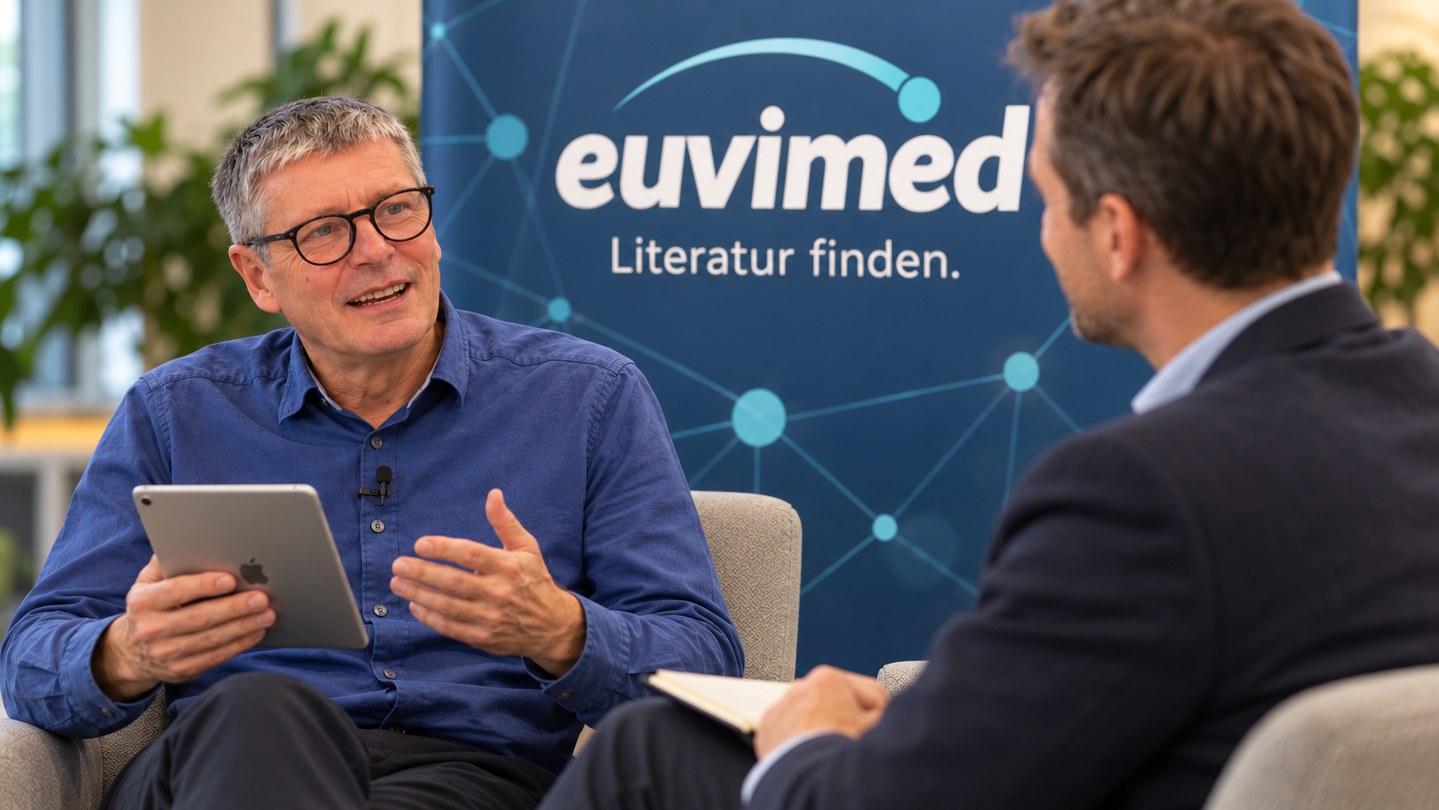

How closely do your collections follow current publishing activity?
We compare connected sources at short, defined intervals. We query important external metadata and search services every four hours; these include, for example, DOI data, OpenAlex, Europe PMC and CareLit. We check direct publisher deliveries through a daily comparison. These daily updates help us keep our collections current.
It is important to distinguish clearly between two things: our retrieval interval does not tell us when a publisher supplies a new article or a correction. Timeliness also depends on receipt from the relevant source and subsequent processing. For literature searches, therefore, fast imports must be accompanied by traceable provenance and information about how up to date the data is.
Can libraries and research institutions connect their existing workflows?
Yes. Interfaces are available for publisher deliveries and libraries. Institutions should be able to continue using their existing workflows as far as possible. We therefore provide access for the Entrez functions that we support: familiar query parameters can be retained, while the endpoints being addressed can be switched to EUVIMED.
Compatibility has to prove itself in the specific workflow. Before switching, it is therefore necessary to check which functions an application uses and which responses it expects. An interface is only useful if it fits reliably into an institution’s everyday work.
What does your European ambition mean for medical subject headings?
We are initially using MeSH, the established medical subject vocabulary. It helps bring literature together even when authors use different terms. A complete redevelopment would currently be neither realistic nor in the interests of people working with existing search strategies.
At the same time, we must create the conditions for further developing indexing and enabling subject-specific additions. This is a long-term task that requires cooperation and clear responsibilities. A server of our own does not, by itself, create an independent medical knowledge system.
Which literature would you like to make more visible?
We want to broaden literature searching beyond the familiar biomedical core. This includes smaller journals, open-access publications and, in particular, German-language specialist literature. Our service includes, for example, more than 500 German-language specialist journals. For nursing, therapy and care practice, these contain knowledge that can easily be overlooked by a search focused exclusively on internationally visible titles.
A publication does not become unimportant simply because it is absent from a major database. At the same time, a broader offering must not lead to different publication types and quality levels being treated as equivalent. Traceable sources and professional assessment are essential. Our aim is a more complete picture of the literature that may be relevant to a specific question.
What tasks does AI perform at EUVIMED?
One important application already operates behind the search interface. In a data environment involving more than 12,000 journals and publishers, delivery formats and structures change repeatedly. Specialised AI helps us match metadata, identify anomalies and prepare adjustments to data ingestion. At this scale, it is not practical to handle every change manually.
For users, we also use AI to present search results, work with full texts and support reviews. Our principle is this: AI may help make sources accessible. Professional responsibility remains with people. We want to make it clear where AI is involved and which sources support a statement. The AI functions can be switched off; conventional literature searching remains available.
How do you handle data protection and sensitive medical search queries?
EUVIMED is operated in Germany. For us, the GDPR is a requirement governing the design of the platform and its data processing. Healthcare institutions in particular must be able to understand what information is processed, which service providers are involved and who bears responsibility. Location is an important element; the actual data flows and safeguards are equally important.
Medical search terms can become particularly sensitive when they allow conclusions to be drawn about specific individuals. Patient names and other identifying information therefore have no place in general literature searches. The use of AI also requires clear boundaries and a conscious decision by users. Data protection belongs at the start of a search, not at its end.
A database needs reliable operation over many years. Who supports that?
Today, EUVIMED is operated by hpsmedia. We bring experience in making specialist literature accessible and in operating databases, including through CareLit. For further development, we are seeking broader cooperation with universities and other institutions involved in information provision.
Lasting reliability does not result from a one-off technical investment. It requires ongoing data maintenance, professional feedback and sustainable funding. We therefore want to agree with partners on how responsibility for content, development and operation can be shared over the long term. Building this cooperation is part of the next phase of development.
What do you expect from clinics, universities and policymakers?
We would like scientific information provision to be recognised as a shared responsibility. Research, teaching and care draw on the same foundations, but bring different questions and resources. Clinics and other institutions can therefore contribute a great deal: through specific literature-search tasks, professional feedback, cooperation and support for further expansion.
We are also actively approaching policymakers, potential funders and funding programmes. A funding application is being prepared. Additional resources would help us develop data connections and functions further and put cooperation on a broader footing. Our invitation to policymakers is this: let us assess Europe’s capacity to act through a concrete infrastructure and its usefulness in everyday work.
How can interested parties follow EUVIMED or get involved?
At euvimed.com, we provide information about the platform, its sources and further developments. Interested parties can also find contact details there. We particularly welcome institutions that try EUVIMED with their own specialist questions and tell us where the search helps them move forward and where something is still missing. A reliable knowledge infrastructure has to prove its worth in the work of the people who use it.
Short quotations for editorial use
“Medical knowledge must not become an instrument of political pressure.”
“Resilience becomes evident when a data route fails.”
“A publication does not become unimportant simply because it is absent from a major database.”
“AI may help make sources accessible. Professional responsibility remains with people.”
“Data protection belongs at the start of a search, not at its end.”
“A server of our own does not, by itself, create an independent medical knowledge system.”
Further information and contact: https://euvimed.com
Interview & images for download
The full interview text and both images are available here separately and as a joint press package. Download the images in their original resolution.